
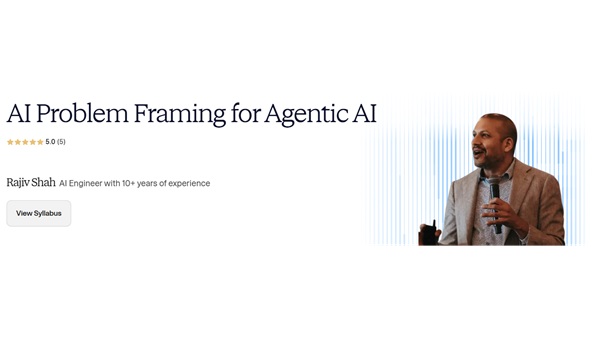
[GroupBuy] AI Problem Framing for Agentic AI
$49.00
Discount 20% if your total cart over $150
- Satisfaction Guaranteed
- Fast and forever download link
- Secure Payments
- Reupload FREE
Description
Effective AI implementation is increasingly dependent on AI Problem Framing for Agentic AI, a foundational thinking skill described as being as critical to AI teams as System Design is to software engineers. This critical capability moves beyond mere technical execution, demanding an AI Architect mindset that meticulously scopes challenges, rigorously questions requirements, and possesses the diagnostic acuity to pinpoint whether failures originate from data, architecture, or the initial problem framing. It is the cornerstone for transforming successful demos into robust, production-ready Agentic AI systems capable of delivering true business value.
The Foundational Imperative of AI Problem Framing
In the rapidly evolving landscape of artificial intelligence, the distinction between a technical demonstration and a production-grade system has become starker than ever. Many organizations find themselves caught in a cycle of impressive proofs-of-concept that fail to translate into tangible, scalable business solutions. This pervasive issue underscores the critical need for AI Problem Framing, a disciplined approach to defining, understanding, and structuring AI challenges before a single line of code is written. It is not merely a pre-development step; it is the intellectual bedrock upon which all successful Agentic AI projects are built, ensuring that technical prowess is directed towards solving the right problems, not just any problem. Without this foundational skill, teams risk expending vast resources on solutions that are technically sound but fundamentally misaligned with strategic objectives, leading to a significant waste of development cycles and a perpetuation of the dreaded “demo to production gap.”
Bridging the Demo-to-Production Gap
The journey from a captivating demo to a resilient production system is fraught with challenges, many of which are non-technical in nature. Demos often thrive in controlled environments, using curated datasets and simplified assumptions that do not reflect the chaos and variability of real-world operations. This gap is a primary symptom of inadequate AI Problem Framing. When the problem itself isn’t rigorously defined, the solution, however elegant in its technical execution, will inevitably falter when confronted with the complexities of actual deployment.
Addressing this gap requires a shift in focus from merely showcasing what an algorithm can do to understanding precisely what problem it must solve under real-world constraints. It involves asking difficult questions early: What constitutes success in a production environment? What are the edge cases that could break the system? What are the true operational costs and dependencies? Without this deep, critical inquiry, AI projects remain perpetually stuck in a state of perpetual piloting, never quite achieving the robust reliability and scalability required for enterprise adoption. AI Problem Framing for Agentic AI forces teams to confront these realities upfront, moving beyond the superficial allure of a successful demo to build systems designed for durability and impact.
Diagnosing Failure: Beyond Algorithms to Framing
A common misconception in AI development is that project failures are primarily due to algorithmic shortcomings or technical implementation errors. While these certainly play a role, the documentation highlights a more profound and often overlooked truth: the majority of AI project failures are attributable to flawed problem framing. This means that teams are often building perfectly functional systems, but for the wrong problem. It’s akin to building an incredibly efficient automobile when the real need was for an airplane – both are feats of engineering, but only one addresses the actual transportation challenge.
Diagnosing these failures requires an analytical shift from examining the “how” of the solution to scrutinizing the “why” of the problem. Was the problem correctly identified and scoped from the outset? Were the underlying assumptions valid? Was the ultimate goal clearly articulated and understood by all stakeholders? When a system underperforms or fails in production, the first instinct might be to tweak the model or optimize the infrastructure. However, an AI Architect, skilled in AI Problem Framing, understands that the most impactful intervention might be to reassess the very definition of the problem itself. This diagnostic capability is what differentiates a truly effective AI team from one that perpetually chases technical fixes for fundamentally misframed challenges.
The AI Architect Mindset: From Executor to Strategist
The transition from a purely execution-focused role to that of an AI Architect signifies a profound mindset shift, one that places ownership of the problem at its core. This role demands more than just technical proficiency; it requires a strategic vision, an inquisitive nature, and the courage to challenge established norms. An AI Architect doesn’t just build what is asked; they question why it is asked, scrutinizing requirements with a critical eye and pushing back with evidence when necessary.
This architectural mindset is essential for navigating the specialized demands of AI, especially for leaders transitioning from traditional engineering or product management. It involves understanding the unique complexities of data, model biases, ethical implications, and the inherent uncertainty of AI systems. The AI Architect leverages their expertise in AI Problem Framing for Agentic AI to guide stakeholders towards solutions that are not only technically feasible but also strategically sound and aligned with long-term business objectives. They act as the bridge between technical execution and business value, translating complex AI trade-offs into understandable terms for non-technical leaders and advocating for approaches that maximize impact and minimize wasted effort. This strategic foresight is paramount in ensuring that AI investments yield meaningful returns rather than becoming costly experiments.
Mastering The Loop – A Framework for Navigating AI Complexity
The journey of an AI project, particularly with the emergent complexities of Agentic AI, is rarely linear. It’s a dynamic process fraught with uncertainty, evolving requirements, and unforeseen challenges. To navigate this intricate landscape, a systematic methodology is indispensable. The Loop emerges as precisely such a framework – a five-step, iterative process designed to imbue rigor and clarity into AI project development and decision-making. It transforms an otherwise chaotic endeavor into a structured exploration, ensuring that every decision, every assumption, and every technical choice is continually evaluated against the ultimate objective. This methodology is not just a checklist; it’s a cognitive discipline that fosters continuous learning and adaptation, moving teams beyond reactive problem-solving to proactive strategic intervention. By embedding The Loop into their workflow, AI teams can systematically de-risk projects, optimize resource allocation, and consistently align their efforts with the strategic intent derived from robust AI Problem Framing.
The Loop provides a vital mechanism for teams to move beyond mere execution, fostering a culture of critical inquiry and evidence-based decision-making. It addresses the inherent ambiguity in AI projects by breaking down complex problems into manageable, analyzable components. This structured approach allows for early detection of misalignments and facilitates rapid course correction, preventing the costly accumulation of errors that often plague poorly framed AI initiatives.
- Outcome: Defining the ultimate goal and what success looks like.
- Assumptions: Identifying and validating the underlying beliefs driving the solution.
- Alternatives: Considering different approaches (e.g., search vs. a chatbot).
- Trade-offs: Analyzing the compromises inherent in any chosen path.
- Signals: Identifying indicators that reveal if the system is working or broken.
Iterative Scoping with Outcomes and Assumptions
The first two steps of The Loop, “Outcome” and “Assumptions,” are foundational to effective AI Problem Framing. They compel teams to articulate precisely what they are trying to achieve and why, before diving into the “how.” Defining the “Outcome” means moving beyond vague aspirations to concrete, measurable definitions of success. What does a triumph look like in a production environment? How will it impact the user, the business, or the overarching strategy? This clarity of purpose acts as the North Star for the entire project, ensuring that every subsequent decision is aligned with the ultimate objective. It prevents scope creep and ensures that resources are allocated to features that genuinely contribute to the desired impact.
Following outcome definition, the rigorous identification and validation of “Assumptions” become paramount. Every AI project is built upon a myriad of underlying beliefs – about data availability, user behavior, system performance, or the very nature of the problem itself. Unchallenged assumptions are silent killers of AI projects, often leading to spectacular failures in production. The Loop encourages teams to explicitly list these assumptions, subject them to scrutiny, and, where possible, validate them with data or controlled experiments. This iterative process of defining outcomes and stress-testing assumptions is central to robust AI Problem Framing, minimizing the risk of building elegant solutions for non-existent or misunderstood problems. It imbues projects with a layer of intellectual honesty, forcing teams to confront potential weaknesses early in the development cycle.
Strategic Pivoting through Alternatives and Trade-offs
Once outcomes are defined and assumptions are critically examined, The Loop guides teams through the exploration of “Alternatives” and the analysis of “Trade-offs.” This stage encourages creative problem-solving and discourages premature commitment to a single technical path. Instead of immediately defaulting to the trendiest AI technique (e.g., “we need a generative chatbot”), teams are prompted to consider a diverse range of approaches that could achieve the desired outcome. Could a simpler search interface be more effective? Would a rule-based system suffice? This exploration is not about avoiding advanced AI, but about choosing the most appropriate solution that aligns with the problem framing and desired outcomes.
The consideration of alternatives naturally leads to a deep dive into “Trade-offs.” Every technical decision, every architectural choice, comes with inherent compromises. Opting for higher accuracy might mean slower inference times; greater model complexity could increase maintenance costs or reduce explainability. The Loop mandates a transparent analysis of these trade-offs, enabling teams to make informed decisions that balance competing priorities. This step is particularly crucial in Agentic AI, where the interplay of various components can introduce complex interdependencies. By explicitly analyzing trade-offs, teams can anticipate potential bottlenecks, manage stakeholder expectations, and proactively design for resilience, ensuring that the chosen path is not just technically feasible but also strategically viable. This process is a testament to the discipline of AI Problem Framing, moving beyond simplistic solutions to embrace the nuanced reality of AI development.
The Power of Signals in Continuous Evaluation
The final step of The Loop, “Signals,” closes the feedback loop and transforms AI development into a continuous learning process. Signals are the quantifiable indicators that reveal whether the system is performing as intended, whether the initial framing of the problem was correct, and whether the underlying assumptions remain valid. These are not merely technical metrics but holistic indicators that reflect business impact and user experience. For instance, if the outcome was to reduce customer service call volume, a signal might be the actual reduction in calls, not just the chatbot’s answer accuracy.
The ability to identify and monitor effective signals is critical for continuous evaluation and adaptation. It allows teams to move beyond successful demos to durable production systems by providing real-time insights into system health and effectiveness. When signals indicate unexpected behavior or a deviation from the desired outcome, it triggers a re-evaluation of the entire Loop, prompting questions about the initial framing, assumptions, alternatives, and trade-offs. This iterative nature of The Loop, driven by robust signal monitoring, empowers AI Architects to diagnose whether a failure stems from data issues, architectural flaws, or, most critically, a misstep in the initial AI Problem Framing. It ensures that AI projects remain agile, responsive, and continuously aligned with evolving business needs and real-world performance.
Strategic Intervention: Fixing Data, Architecture, or Framing
The journey from an AI concept to a production-ready system is frequently punctuated by failures. However, not all failures are created equal, and the ability to accurately diagnose their root cause is paramount to success. A central theme emphasized in the documentation is the nuanced understanding that failures can manifest at various levels, demanding distinct categories of intervention. Blindly applying a fix without a precise diagnosis often leads to wasted effort, compounding the initial problem rather than resolving it. This diagnostic acumen is a hallmark of the AI Architect mindset, enabling teams to move beyond superficial symptoms to address the true underlying issues. It’s about asking, “What is actually broken?” rather than just, “How do we make it work?” This methodical approach to failure analysis, rooted in strong AI Problem Framing, ensures that interventions are targeted, efficient, and ultimately effective in building resilient AI systems.
The framework proposes a hierarchical approach to diagnosing issues, recognizing that the most fundamental problems often reside in the earliest stages of conception. This hierarchy provides a clear pathway for troubleshooting, guiding practitioners to investigate from the lowest level of abstraction (data) to the highest (framing of the problem itself). Such an organized diagnostic strategy prevents teams from endlessly tinkering with algorithms or infrastructure when the core issue lies in a misunderstanding of the problem they set out to solve.
The Hierarchy of AI Failure Diagnosis
When an Agentic AI system falters in production, the first impulse might be to dive into the code or retrain the model. However, an effective AI Architect adopts a more structured diagnostic approach, akin to a medical doctor systematically ruling out causes. The documentation outlines a clear hierarchy of intervention levels: “Fix the Data,” “Fix the Architecture,” and “Fix the Framing.” This structured thinking is crucial because the most impactful fix often lies at the highest level of abstraction. Beginning with “Fix the Data” addresses issues at the foundational information layer. Is the data clean, representative, and complete? Are there biases or inconsistencies that undermine the model’s performance? Often, seemingly complex model failures can be traced back to fundamental data quality issues.
If the data is deemed sound, the next level of intervention is “Fix the Architecture.” This involves redesigning the technical structure or optimizing components like RAG (Retrieval-Augmented Generation) pipelines. Are the components interacting efficiently? Is the infrastructure scalable and robust? Are there bottlenecks in data flow or processing? Only after these lower-level issues have been thoroughly investigated and addressed does the AI Architect ascend to the most profound level of diagnosis: “Fix the Framing.” This final, and often most challenging, intervention recognizes that the problem itself was incorrectly defined. It demands a pivot, a re-evaluation of the initial premise, and a willingness to acknowledge that the team might have been solving the wrong problem all along. This systematic progression ensures that solutions are not just patches but fundamental rectifications, rooted in a deep understanding of AI Problem Framing.
Evidence-Based Pushback and Stakeholder Translation
The role of an AI Architect extends beyond technical diagnosis; it encompasses a crucial responsibility to guide stakeholders towards optimal solutions, even if it means challenging initial requests. This is where “Evidence-Based Pushback” becomes a vital skill. Stakeholders, often driven by business needs or popular trends, might request a specific AI solution (e.g., “we need a generative chatbot for customer service”). However, the AI Architect, armed with data and a deep understanding of AI Problem Framing, might demonstrate why an alternative, perhaps simpler, solution like an enhanced search interface could be superior for the defined outcome. This isn’t about saying “no”; it’s about using empirical evidence and a thorough understanding of trade-offs to steer the project towards a more effective and sustainable path.
Coupled with pushback is the necessity of “Stakeholder Translation.” The world of AI is rife with complex terminology, nuanced trade-offs, and probabilistic outcomes that can be opaque to non-technical leaders. The AI Architect must act as a translator, communicating these complexities in business terms that are understandable, relevant, and actionable. They articulate the implications of technical choices on cost, time, user experience, and strategic objectives. This ability to bridge the communication gap ensures that decisions are made with a clear understanding of their consequences, fostering trust and alignment between technical teams and business leadership. It’s a testament to the comprehensive nature of the AI Architect’s role, where technical insight, strategic thinking, and effective communication converge to drive successful AI Problem Framing.
Learning from Scars: A Pedagogical Approach to AI Maturity
The provided insights are not theoretical constructs but are grounded in the hard-won lessons from analyzing over 200 AI failures. This experience-based approach forms a powerful pedagogical methodology, aiming to equip practitioners with years of practical wisdom without having to endure every mistake themselves. By studying the “scars” from past projects – the warning signs of bad framing, the insidious nature of unchallenged assumptions, and the pitfalls of misaligned solutions – practitioners can develop an intuitive understanding of what can go wrong before expensive mistakes are made. This proactive learning is invaluable, transforming potential crises into opportunities for early intervention.
This methodology emphasizes “Failure Analysis” as a core learning component, providing a library of case studies that illustrate the diverse ways AI projects can derail. It also focuses on “End-to-End Scoping,” mastering the full lifecycle of an AI Agent project from initial conception and problem framing to debugging and deployment. Finally, “Practical Application” ensures that these frameworks are not just academic exercises but are applied to real-world Agentic AI projects and enterprise use cases, such as recommendation systems and RAG pipelines. This holistic approach cultivates a deep understanding of AI Problem Framing, enabling practitioners to move beyond superficial successes to build durable, impactful AI systems that truly solve the right problems and withstand the rigors of production environments.
The Visionary Behind the Framework: Rajiv Shah’s Contributions
The advancements and methodologies described within this framework are not born from abstract theory but from a rich tapestry of practical experience and profound academic insight. At the heart of this transformative approach to AI development stands Rajiv Shah, an Agentic AI Engineer at OpenHands, whose contributions have profoundly shaped the understanding of what it takes to move AI from promising demos to robust, production-ready systems. His work underscores the critical role of AI Problem Framing as the linchpin for successful AI deployment, arguing that without a clear, well-defined problem, even the most sophisticated algorithms are destined for underperformance or outright failure. Shah’s unique blend of hands-on technical expertise, rigorous academic background, and a philosophical inclination towards learning from failure provides a compelling foundation for the methodologies he advocates. His insights offer a roadmap for practitioners and organizations alike to navigate the treacherous waters of AI implementation, ensuring that efforts are directed towards solutions that are not only technically sound but also strategically aligned and genuinely impactful.
Shah’s philosophy is particularly impactful because it challenges the pervasive myth that AI failures are primarily a result of technical shortcomings. Instead, he consistently points to the upstream issue of framing – a cognitive and strategic challenge that precedes and underpins all technical execution. This perspective is a game-changer, shifting the focus from endless algorithmic tweaking to a more fundamental re-evaluation of the problem space itself.
Blending Deep Technical Expertise with Practical Application
Rajiv Shah’s credibility in the field of AI Problem Framing is firmly rooted in his extensive “Technical Experience,” boasting hands-on work with over 100 AI use cases across a diverse spectrum of enterprises, startups, and research institutions. This breadth of exposure has provided him with an unparalleled understanding of the challenges and nuances inherent in different AI applications, from complex recommendation systems to intricate RAG pipelines. His experience isn’t limited to theoretical concepts; it’s forged in the crucible of real-world implementation, where data is often messy, requirements are fluid, and production environments are unforgiving. This practical immersion allows him to speak with authority on the pain points and success factors of AI projects, particularly how crucial solid AI Problem Framing is to navigate these varied contexts.
Beyond his impressive practical portfolio, Shah also brings a formidable “Academic Credential” to the table, holding a PhD from the University of Illinois Urbana-Champaign (UIUC) and serving as a Professor. This academic rigor ensures that his methodologies are not just anecdotal but are built upon a foundation of structured thought, critical analysis, and deep theoretical understanding. The combination of his academic background with his extensive practical experience creates a unique synergy, allowing him to bridge the gap between cutting-edge research and pragmatic, implementable solutions. His work is a testament to the power of integrating academic depth with real-world application, offering a holistic perspective on AI development that is both intellectually robust and immediately actionable.
The Philosophy of Failure and the Pursuit of Durable Systems
Central to Rajiv Shah’s teachings is a profound “Philosophy” that posits failures are, in fact, more instructive than successes. This counter-intuitive perspective challenges the conventional wisdom that success should be the primary object of study. Instead, Shah argues that failures expose the true fragilities, the hidden assumptions, and the fundamental misalignments that successes often mask. His analysis of 200+ AI failures has led him to a singular, compelling conclusion: the majority of these failures are attributable to framing rather than algorithmic shortcomings. This insight is revolutionary, shifting the blame from the “how” of AI – the models and algorithms – to the “what” and “why” – the initial definition and understanding of the problem itself.
This emphasis on learning from failure is not about dwelling on mistakes but about proactively identifying “warning signs of bad framing” before they escalate into “expensive mistakes.” By meticulously dissecting what went wrong in past projects, Shah provides practitioners with a preventative framework, enabling them to recognize the “scars” of poor AI Problem Framing and avoid repeating them. This approach is geared towards moving beyond evanescent “successful demos” to building “durable production systems.” It’s about cultivating resilience and foresight, ensuring that AI solutions are not just momentarily impressive but are robust, sustainable, and capable of delivering long-term value in dynamic, real-world environments. His work essentially offers a shortcut to years of experience by distilling the most critical lessons from collective failures.
Real-World Impact and the Future of Agentic AI
Rajiv Shah’s frameworks and insights are not confined to academic discourse; they are designed for “Real-World Application” and tangible impact, particularly in the burgeoning field of Agentic AI. His work aims to empower practitioners to master the “End-to-End Scoping” of Agentic AI projects, from the initial conceptualization and rigorous problem framing to the intricate debugging processes required for complex, autonomous systems. This practical focus ensures that his methodologies are directly applicable to current enterprise use cases, whether it’s optimizing recommendation systems, enhancing RAG pipelines, or developing novel Agentic applications that require sophisticated decision-making capabilities. The goal is to move beyond abstract theory to deploy AI solutions that genuinely solve business problems and provide a competitive edge.
The “Innovation” driven by Shah’s approach is further evidenced by his personal achievements, including holding over 20 patents and being cited over 1,000 times in research. This blend of practical inventiveness and academic influence highlights his commitment to advancing the field in a meaningful way. His work fundamentally reshapes how organizations approach AI development, instilling a discipline that prioritizes strategic thinking over mere technical execution. By championing robust AI Problem Framing, Shah is not just advocating for better AI projects; he is laying the groundwork for a future where Agentic AI systems are not only intelligent but also reliably aligned with human intent and real-world needs, ensuring that their potential is fully realized in durable, impactful ways.
Conclusion
The evolution of AI from academic curiosity to a cornerstone of enterprise operations necessitates a fundamental shift in how projects are conceived and executed. AI Problem Framing for Agentic AI, as championed by Rajiv Shah, emerges as the indispensable skill that underpins this transformation. It moves beyond the limitations of technical evaluations and successful demos, advocating for an AI Architect mindset that meticulously defines outcomes, critically examines assumptions, explores diverse alternatives, analyzes trade-offs, and relies on robust signals for continuous evaluation—a systematic approach encapsulated by The Loop.
By emphasizing the diagnosis of failures at the data, architecture, or, most critically, the framing level, this methodology empowers practitioners to build durable production systems that address the right problems, learning from a rich history of over 200 AI failures. This holistic perspective, blending deep technical expertise with a profound philosophy of learning from mistakes, is the blueprint for delivering impactful and sustainable Agentic AI solutions in the complex real world.
Sales Page:_https://maven.com/rajistics/ai-problem-framing
Delivery time: 12 -24hrs after paid